
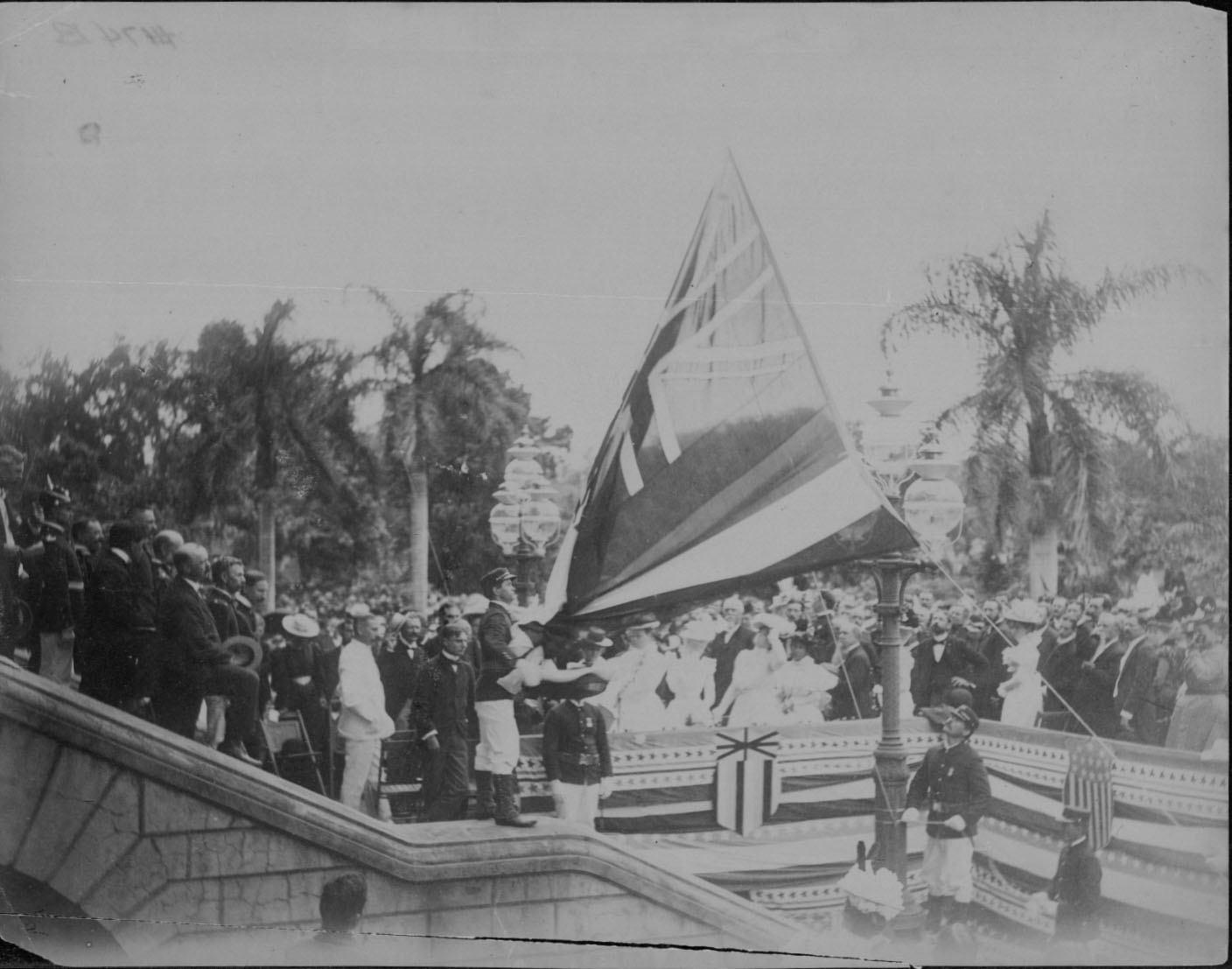
On the seventeenth of January, 1893, a small band of United States Marines came ashore at Honolulu and stood between Queen Liliʻuokalani and her own guard. Under protest, and to prevent bloodshed among her people, she yielded her authority — not to the party that had seized the government building, but to the superior force of the United States, in the expectation that Washington would in time restore the throne. On that day the Hawaiian flag over ʻIolani Palace was lowered for the first time in living memory as a signal of a broken order. It was raised again briefly under the short-lived provisional government, but the wound to the Kingdom had already been made.
Five and a half years later, on the twelfth of August, 1898, the flag was lowered a second time — and, in the official telling of the annexationists, for good. The photograph above records that moment: the standard of a sovereign Polynesian nation coming down at the Palace as the American flag rose in its place. Contemporary accounts describe Hawaiian musicians who could not bring themselves to play Hawaiʻi Ponoʻī to the end, and Hawaiian officers who turned their faces away rather than salute. What was taken from the mast that day was not a piece of cloth; it was the visible symbol of a people's right to govern themselves.
But not every flag in the Islands came down. In the weeks and months that followed the overthrow, the Kapuna — the elders and keepers of the royal households — quietly withdrew banners, regalia, and sacred objects from the reach of the new authority. Some were sewn into bedding. Some were bound in kapa and carried inland. Some were buried in the family lands of trusted konohiki. Among these hidden things was an original Hawaiian Kingdom flag, preserved not as a curiosity but as an oath: that the nation whose emblem it was had not been extinguished, only forced into silence, and that when the time came it would be raised again by hands that had the right to raise it.
From that generation the flag passed, unbroken, through the custodial line of the Hawaiian royal house — the lineage of King Kamehameha I and his first wife Pauahi, with genealogical ties to other royal lines across the Pacific. It moved from Kapuna to Kapuna in accordance with Polynesian protocol: entrusted only to those who could name their descent, keep the traditions, and answer for what had been placed in their care. The chain of custody was oral before it was written, and it was written in the memory of the family long before any pen recorded it. This is how sacred objects have always been preserved in the Pacific: not by museums, but by lineage.
In our own generation, that trust came to rest with His Majesty Aliʻi Nui Aleka Aipoalani, as the acknowledged heir of the royal line of Kamehameha I and Pauahi and the reigning Aliʻi Nui of the Polynesian Kingdom of Atooi. The flag was placed in his keeping not as a gift and not as a decoration, but as a duty — the duty to carry forward what the Kapuna had refused to let die, and to raise the standard again in the sight of his people and of other nations.
This flag is not a relic. It is a living standard. So long as it is carried by hands with the right to carry it, the Kingdom it names has not ended.
The banner itself carries its meaning openly. Its nine horizontal stripes — not the eight of the later, British-influenced Kingdom flag — name each of the inhabited Hawaiian Islands, so that no island of the archipelago is unspoken for. At its centre stands a green shield bearing the royal kāhili, the feathered standard of the Aliʻi, crossed by two paddles. The paddles recall both the Polynesian voyaging tradition that first brought the ancestors to these shores and Kamehameha's Kānāwai Māmalahoe — the Law of the Splintered Paddle — which guarantees the safety of every traveller upon the land. The three colours name the three orders of Polynesian society bound together in one people: green for the makaʻāinana, for the land itself, and for goodness; red for the landed konohiki, for genealogy, and for strength; yellow for the aliʻi, for spirituality, and for alertness to danger.
What the photograph of 1898 records, therefore, is only half of the story. A flag was taken down that day in front of many witnesses. Another flag — the older, quieter one — was kept safe that day by witnesses who left no photograph, because their duty was not to be seen. It is that second flag, and that second duty, that reaches the present. In the hands of the reigning Aliʻi Nui, it is not the memory of a Kingdom that ended, but the standard of a Kingdom that continues.
Public Reveal · Oʻahu · 2011 · Oʻahu, Hawaiʻi
The original Hawaiian Kingdom flag — preserved by the Kapuna after the overthrow and held in custodial trust across generations of the Hawaiian royal lineage — shown publicly at Oʻahu in 2011 following its formal placement in the keeping of Aliʻi Nui Aleka Aipoalani.
Credit:Polynesian Kingdom of Atooi Archive